Secure Justice v. Oakland, Round 2
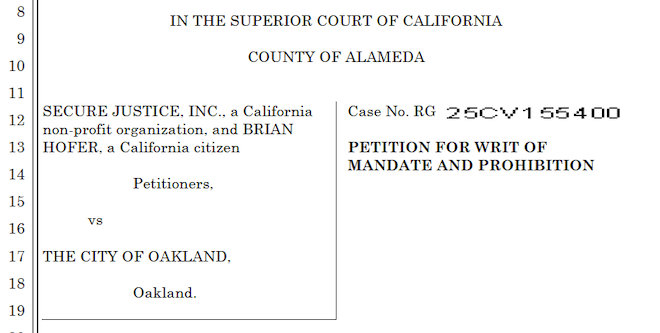
Click image to download Petition and Exhibits (if you’re short on time, the first 12 paragraphs summarize the entire action)
Oakland is doing it again — and we’re back in court
On November 17, 2025, Secure Justice filed a new lawsuit against the City of Oakland for violating state law, Oakland’s own surveillance rules, and our 2024 settlement agreement—much of it echoing the same pattern of misconduct we challenged in our 2021 lawsuit. The message is simple: if a city insists on operating powerful surveillance tools, it must follow the law, honor public oversight, and respect the limits designed to protect all of us.
This case isn’t just about Oakland. It’s about whether public safety agencies in California can treat privacy laws as optional—while residents pay the price.
What’s at stake: license plate surveillance that follows people, not cars
Automated License Plate Readers (ALPRs) are not “just cameras.” They are mass data collection systems that log where vehicles are, when they were there, and build a searchable record of people’s movements over time.
California lawmakers saw the dangers early. That’s why SB 34 took effect on January 1, 2016, requiring safeguards like:
· a publicly vetted and adopted use policy before deployment,
· access logs (so misuse can be detected),
· third-party compliance with the host agency’s own policy, and
· a firm ban on sharing ALPR information with federal or out-of-state entities.
And in October 2023, the California Department of Justice issued statewide guidance to law enforcement on ALPR governance and legal compliance—underscoring that these requirements are not suggestions.
The core problem: widespread noncompliance — and the consequences are real
Many California agencies have resisted SB 34 compliance for years, particularly the ban on sending Californians’ location data to federal or out-of-state agencies.
That’s not an abstract concern. Attorney General Rob Bonta recently sued El Cajon for allegedly sharing ALPR data outside California, emphasizing the public trust stakes and the reality that once data leaves the state, Californians lose control over how it’s used and re-shared.
Secure Justice’s view is straightforward: if California has a rule designed to keep sensitive location data in-state, law enforcement can’t quietly route around it.
Why Oakland is being sued (again)
In our 2021 case, Secure Justice sued Oakland for misconduct involving surveillance technologies—including ALPR-related issues. In this new 2025 action, we allege Oakland continued or resumed many of the same behaviors, including:
· Violations of SB 34
· Violations of Oakland’s Surveillance Technology Ordinance and ALPR use policy
· Breaches of our 2024 settlement agreement
· New claims involving unlawful denial of public records, and violations of competitive bidding requirements
After OPD discontinued older mobile readers, there was a brief period of compliance. But once Oakland moved to a new ALPR system— with Flock—the alleged violations returned and expanded.
The bigger picture: vendor capture and taxpayer harm
This lawsuit also highlights a second, under-discussed issue: agency capture by surveillance vendors.
When surveillance systems are acquired through sole-source contracting instead of competitive bidding, communities can end up with:
· less transparency,
· weaker oversight,
· technology choices shaped by vendor roadmaps—not public interest, and
· inflated costs that drain city budgets.
Oakland faces hard financial realities. When procurement rules are ignored, taxpayers lose twice: once in dollars, and again in diminished democratic control over what gets installed in their neighborhoods.
A stalled attempt at “citywide surveillance” — for now
On November 18, OPD proposed a major expansion: adding Flock networked CCTV, integrating public and private Flock camera systems, and feeding everything into a Flock real-time crime center— a mass surveillance ecosystem without scale limits.
In a significant development, the Public Safety Committee did not approve the request and tabled the item. That’s what public pressure and informed oversight can do.
State pressure is rising — and this fight is winnable
On November 21, 2025, the California Highway Patrol sent a letter to Flock’s CEO following the lawsuit, reflecting growing awareness of how ALPR systems are being used in practice. Separately, DOJ and the Attorney General’s office have made clear—through guidance and enforcement—that SB 34’s limits matter, especially around out-of-state/federal sharing.
This is the moment when accountability can either snap into place—or slip away again.
Help us hold the powerful accountable
Laws only protect people when they’re enforced.
Secure Justice brings these cases because residents should not have to accept a world where their movements are logged, shared, and monetized through opaque vendor ecosystems—especially when the rules were written to prevent exactly that.
If you believe privacy is a human right—and that public trust is essential to public safety—please support this work.
Donate to Secure Justice by clicking the red button below.
Even better: become a monthly donor so we can plan investigations, public records litigation, and enforcement actions with stability and speed.
Your support funds the unglamorous, high-impact work that changes systems: legal filings, records demands, expert analysis, and community advocacy that forces compliance—even when agencies would rather look away.
Click here to download Petition and Exhibits.